How to Operate Multiple Battery Powered Machine Skates Together (Synchronous Operation)
When a single battery powered machine skate cannot handle the load — long, wide, or extra-heavy machines, transformer blocks, ship engine parts, steel mill rolls — you need to run two or more skates in synchronous operation from a single remote. This guide explains how multi-skate synchronization works, when to use it, and the safety rules every operator must follow.
What Is “Synchronous Operation” in Machine Skates?
Synchronous operation (sometimes called “synchronous lifting” or “multi-skate coordination”) is the ability of two or more battery powered machine skates to receive commands from a single wireless remote and execute them at the exact same speed, direction and timing. The drive wheels on every skate stay phase-locked, so the load travels as a single rigid unit — no twisting, no slipping, no crew needed to align the skates manually.
When You Need Multi-Skate Synchronous Operation
- Long machines (lathes, planers, extrusion lines, gantry frames) — front and rear skates stay aligned along the travel direction.
- Wide loads (transformer housings, generator stators) — left and right skates move in lockstep to prevent side-load.
- Extra-heavy assemblies (ship engine blocks, steel mill rolls, forging dies) — 4 or more skates share the load when one skate’s traction is insufficient.
- Continuous operation — while one skate is being recharged, the other keeps the production line moving.
How to Set Up a 3-Skate Train (Most Common Configuration)
The standard “three-skate train” used by most rigging crews is:
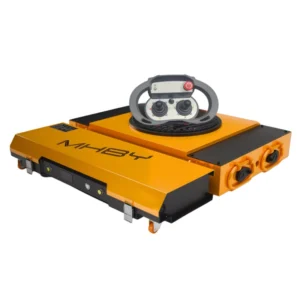
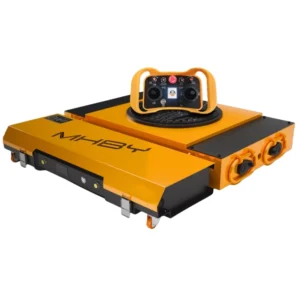
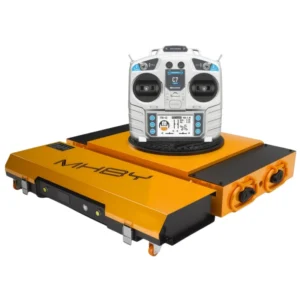
- One battery powered machine skate (front) — the powered unit, controlled by the wireless remote. Choose the tonnage based on heaviest item (e.g. MH50P for 25-ton load, MH100P for 50-ton load).
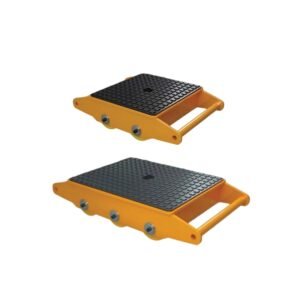
- Two straight-line auxiliary wheels (rear) — passive casters that follow the powered skate in a straight line. Use W6SP (6-wheel) for 20–30 ton hosts, or W8SP (8-wheel) for 40–50 ton hosts.
- One connecting bar — locks the rear auxiliary wheels in line with the powered skate so the train tracks straight.
This configuration can move 60–100 tons with a single operator.
How to Set Up a 4-Skate Synchronized Train (Heavy / Wide Loads)
For loads over 100 tons, run two powered skates (front-left + front-right) plus two straight-line auxiliary wheels (rear-left + rear-right). Both powered skates are paired to one remote and run synchronously. The auxiliary wheels share the rear load. With the MH100P, this train can move 150+ tons.
Safety Rules for Synchronous Multi-Skate Operation
- Test on level ground first. Run the empty train for 5–10 meters to confirm both skates respond in sync before loading.
- Inspect the floor. Cracks, oil, or transitions can desync the skates; mark the travel path in advance.
- Verify load balance. The center of gravity must sit between the powered skates; an off-center load will pull one skate harder than the other.
- Keep one spotter even with synchronous operation. The spotter watches for floor hazards, bystanders, and obstacles.
- Charge all skates before shift. A mid-move battery drop on the rear skate is recoverable; on the front powered skate, it’s a load-shift risk.
Can Battery Powered Machine Skates Work with a Lift?
Yes. The standard workflow for loading a machine onto a battery powered machine skate uses a low-profile claw jack or hydraulic toe jack (sold separately, 10–30 ton) to lift one end of the load 50–100 mm, slide the skate underneath, then lower the load onto the skate. This “remote control electric machine skates with lift function” combination is the most common setup in aerospace, shipbuilding, and energy projects. MHBY’s powered heavy-duty machine skates all accept standard 100–210 mm insertion heights.
Frequently Asked Questions
Q: Can two battery-powered machine skates work together?
A: Yes. Two or more MHBY skates can be paired to a single wireless remote and run synchronously. This is the standard way to move 50–150+ ton loads.
Q: How long does the battery last on machine skates?
A: 4–5 hours of continuous runtime from a 48V 60–120 Ah lithium pack. Carry one spare per powered skate for full-shift operation.
Q: How much weight can battery powered machine skates move?
A: Up to 100 tons traction per skate (MH100P). A 4-skate synchronized train can move 150+ tons.
Need a multi-skate configuration? Browse MHBY battery powered machine skates + straight-line auxiliary wheels, or request a free layout drawing from our engineers.
-
Battery Powered Machine Skates 30-100T | Electric Load Mover
Price range: $5,299.00 through $14,999.00Clear30T50T80T100T -
Electric Load Moving Skates 20-50T | Self-Propelled Skate
Price range: $2,499.00 through $6,399.00Clear20T30T40T50T -
Motorized Machine Skates 20-50T | Battery Powered Skate Basic
Price range: $1,688.00 through $4,699.00Clear20T30T40T50T -
Straight-line Auxiliary Wheels for Machine Skates (W6SP/W8SP)
Price range: $299.00 through $399.00Clear6 Wheels8 Wheels