Battery Powered Machine Skates Buying Guide: 6 Things to Know Before You Order
If you are evaluating battery powered machine skates (also called battery operated machine moving skates, electric machinery mover skates, or remote controlled machine skates) for your factory, warehouse or rigging operation, this guide covers the six factors that determine the right model for your loads. After reading, you will know how to specify tonnage, battery life, traction control, and total cost — and where MHBY’s lineup fits.
1. Match the Skate’s Traction Capacity to Your Heaviest Load
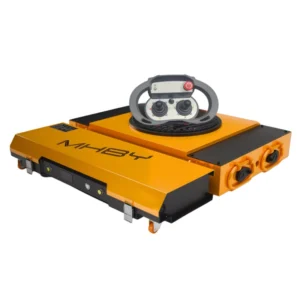
The single most important spec is traction capacity, not load capacity. Traction is the force the drive wheels can exert; load capacity is the maximum weight the frame can safely carry. A good rule of thumb: pick a skate with at least 1.5× the heaviest single-item weight in traction. For most CNC, press, mold and transformer moves, the MHBY MH-P series (30T / 50T / 80T / 100T traction) covers the full range.
2. Understand the Difference Between “Battery Powered”, “Electric” and “Self-Propelled” Machine Skates
In the industry, battery powered machine skates, electric machine skates, self-propelled machine skates, and remote controlled machine skates all refer to the same family of equipment: a low-profile transport platform with a battery-driven motor and wireless remote. Manual machine skates, by contrast, require a crew of 2–6 people to push and steer — a much higher injury and floor-damage risk for loads over 10 tons.
3. Check the Battery Spec: Voltage, Capacity, and Run Time
The industry standard is a 48V lithium battery. The MH-P professional series uses 60–120 Ah packs, delivering 4–5 hours of continuous working time. Look for: removable/swappable battery (so you can keep working with a spare), universal 110–260V charger, and battery level indicator on the control panel.
4. Plan for Synchronous Multi-Skate Operation
For long, wide or extra-heavy loads, you will run two or more battery powered machine skates in synchronized mode from a single remote. Confirm that the manufacturer supports this — not all skates can be paired. MHBY’s MH-P and MH-S series support up to 4 skates running synchronously; pair them with the W6SP / W8SP straight-line auxiliary wheels for stable straight-line transport.
5. Ask About Warranty, Spare Parts, and Lead Time
A quality battery powered machine skates manufacturer should offer at least a 2-year warranty on the drive system and a 5-year warranty on the frame. Confirm spare-part availability (drive motor, remote control, battery, wheels) and lead time for OEM/ODM orders (typically 25–35 days at MHBY). CE / ISO 9001 certification is also a must for European and Middle East shipments.
6. Total Cost of Ownership: Battery Powered vs Manual Skates
Yes, a battery powered machine skates set costs more up front than a manual one. But the ROI is fast: one operator replaces a 4–6 person crew, eliminating labor cost on every move, and reducing injury risk (manual pushes of 20+ tons are a top cause of warehouse back injuries). Most MHBY customers report a payback period of 6–10 months. See our full battery powered vs manual machine skates cost comparison.
Frequently Asked Questions
Q: How much weight can battery powered machine skates move?
A: Up to 100 tons of traction per skate with the MH100P. A synchronized multi-skate train can move 150+ tons. See the full MH-P series specifications.
Q: How long does the battery last on machine skates?
A: 4–5 hours of continuous runtime from a 48V 60–120 Ah lithium pack. The battery is removable; a spare pack keeps you running.
Q: Can two battery-powered machine skates work together?
A: Yes. Two or more skates can run synchronously from a single remote for long, wide or extra-heavy loads. Pair with straight-line auxiliary wheels for the classic three-skate train.
Ready to spec your project? Browse the MHBY battery powered machine skates catalog or contact our engineers for a free consultation.
-
Battery Powered Machine Skates 30-100T | Electric Load Mover
Price range: $5,299.00 through $14,999.00Clear30T50T80T100T -
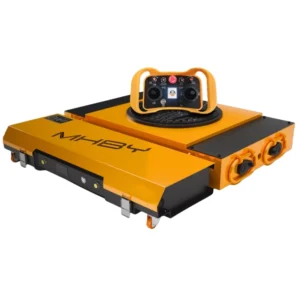
Electric Load Moving Skates 20-50T | Self-Propelled Skate
Price range: $2,499.00 through $6,399.00Clear20T30T40T50T -
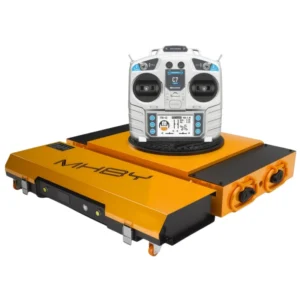
Motorized Machine Skates 20-50T | Battery Powered Skate Basic
Price range: $1,688.00 through $4,699.00Clear20T30T40T50T -
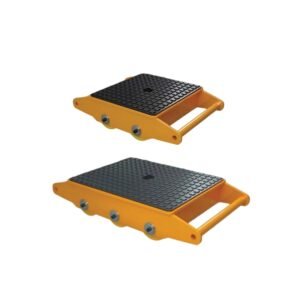
Straight-line Auxiliary Wheels for Machine Skates (W6SP/W8SP)
Price range: $299.00 through $399.00Clear6 Wheels8 Wheels