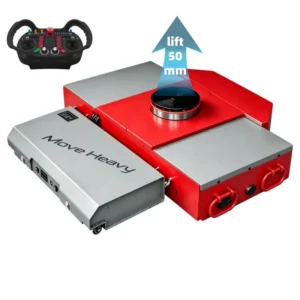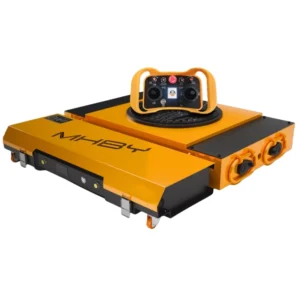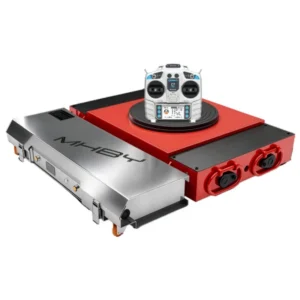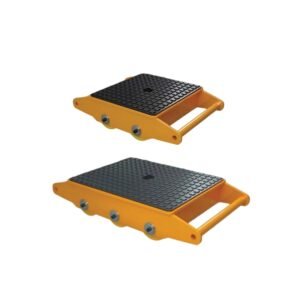
When a plant manager asks whether battery-powered machine skates are worth the investment over traditional manual skates, the honest answer is: it depends entirely on how often you move machinery. But almost every facility that runs the numbers on total cost of ownership (TCO) — not just the purchase price — reaches the same conclusion. This guide breaks down the real math behind both options.
The Purchase Price Gap Is Smaller Than You Think
A set of quality manual machine skates rated for 20–30 tons typically costs between $800 and $3,000 depending on capacity and configuration. A battery-powered electric machine dolly skate in the same class runs higher — but the gap has narrowed sharply as lithium battery and motor technology has matured. The sticker price, however, is where most comparisons wrongly stop.
What Manual Skates Actually Cost Per Move
Manual machine skates are not a one-person tool. Moving a 20-ton machine safely with manual skates requires:
- 3–6 workers to push, steer, and stabilize the load
- Toe jacks or machine jacks for lifting the machine onto the skates
- Rigging bars and crowbars for steering corrections
- Extended downtime — manual moves average 30–60% longer than powered moves
Now run the labor math. If a machinery move takes 4 workers 6 hours at a fully-loaded labor rate of $45/hour, that is $1,080 in labor per move. A facility that relocates machines twice a month spends nearly $26,000 a year on moving labor alone — more than the price of a professional-grade powered skate system.
The Hidden Costs Nobody Puts on the Quote
Injury Risk
Manual heavy-load moving remains one of the leading causes of serious workplace injuries in manufacturing. A single recordable injury — lost time, medical costs, insurance premium increases, and OSHA recordkeeping — can erase years of equipment savings. Powered skates put the operator at a safe distance with a wireless remote control, eliminating the crush and strain exposure entirely.
Equipment and Floor Damage
Manual skates give no speed control on slopes or ramps. A load that gets away from the crew damages machines, racking, and floor coatings. Battery-powered skates drive at controlled speeds — the load goes exactly where pointed, at exactly the speed selected.
Downtime Compounding
Every extra hour a production line sits idle waiting for a machine move costs real output. Facilities that switch to powered skates routinely report move times cut by half — which means production restarts sooner.
Side-by-Side TCO: 3-Year Comparison
| Cost Factor | Manual Skates | Battery-Powered Skates |
|---|---|---|
| Equipment purchase | $1,500–$3,000 | Higher initial investment |
| Workers per move | 3–6 | 1 (remote control) |
| Average move time (20T) | 4–6 hours | 2–3 hours |
| Labor cost @ 2 moves/month | ~$26,000/year | ~$6,500/year |
| Injury exposure | High (crush/strain) | Minimal (operator stands clear) |
| Floor damage risk on slopes | High | Controlled speed |
| Positioning precision | Centimeters (crowbar corrections) | Millimeters (proportional control) |
When Manual Skates Still Make Sense
Honesty matters in equipment selection. Manual skates remain the right choice when you move machinery less than once a quarter, your loads stay under 10 tons, moves are short and flat, and labor is readily available. For everything else — recurring moves, heavy loads, ramps, tight aisles, or valuable machinery — the powered option pays back within 12–24 months.
Frequently Asked Questions
How long do batteries last on a powered machine skate?
Quality lithium battery systems deliver 3+ hours of continuous operation per charge — enough for multiple machine moves. Batteries are typically rated for 800+ charge cycles, meaning years of weekly use.
Can battery-powered skates handle ramps?
Yes. Electric drive with controlled speed handles slopes that are unsafe with manual skates. Always check the manufacturer’s rated slope for your load weight.
What capacities are available?
MHBY battery-powered machine skates cover applications from light equipment to 30+ tons per set. Explore the Basic and Professional lines for your capacity range.
The Bottom Line
Compare the full picture — labor hours, injury exposure, downtime, and floor risk — and battery-powered machine skates win for any facility moving machinery more than a few times a year. Get a factory-direct quote for your load requirements and run the numbers against your own labor rates: most plant managers find the payback period shorter than expected.
-
Battery Powered Machine Skates 20-50T | Electric Load Mover with Lifting Function
Price range: $3,499.00 through $6,399.00Clear20T25T30T35T40T50T -
Electric Load Moving Skates 20-50T | Self-Propelled Skate
Price range: $2,499.00 through $4,899.00Clear20T25T30T35T40T50T -
Motorized Machine Skates 20-50T | Battery Powered Skate Basic
Price range: $1,988.00 through $4,188.00Clear20T25T30T35T40T50T -
Straight-line Auxiliary Wheels for Machine Skates (W6SP/W8SP)
Price range: $299.00 through $399.00Clear6 Wheels8 Wheels