Moving heavy machinery inside a factory is one of the most demanding tasks in industrial operations. Whether you are relocating a CNC machining center, repositioning an injection molding machine, or rearranging a production line, the wrong approach risks damaged equipment, injured workers, and costly downtime. In this guide, we break down the complete process professionals use to move heavy machinery safely — from planning and risk assessment to choosing the right machine moving equipment.
1. Plan the Move Before Touching the Machine
Every successful machinery move starts with a written plan. Document the machine’s weight, dimensions, center of gravity, and lifting points. Then walk the entire route and record:
- Floor condition: load capacity, slopes, expansion joints, and surface damage
- Obstacles: door widths, overhead clearances, cable trays, and pipework
- Utilities: power, gas, and water lines that must be disconnected
- Downtime window: how long production can stop without hurting delivery schedules
A rule of thumb from plant engineers: every hour of planning saves four hours of execution.
2. Assess the Load: Weight Is Only the Beginning
Knowing the total weight is not enough. Heavy machinery moves fail because teams ignore the center of gravity and load distribution. A 20-ton machine with an offset center of gravity behaves completely differently from a balanced one. Check the machine’s installation manual for the CG point, and calculate the point load on each skate or roller before the move.
3. Choose the Right Moving Method
Traditional Options and Their Limits
Most factories still rely on one of these classic methods:
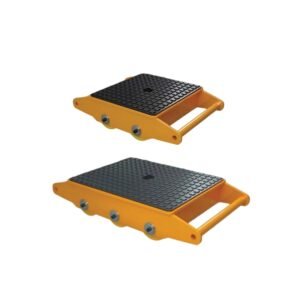
- Manual machine skates: cheap, but require 3–6 workers to push, steer, and stop a multi-ton load. Fine for short, straight moves on smooth floors — dangerous on slopes or turns.
- Overhead cranes: fast where coverage exists, but most factory layouts only cover part of the floor.
- Forklifts: versatile for palletized loads, but lifting a machine’s CG above the forks invites tipping.
The Modern Approach: Battery-Powered Machine Skates
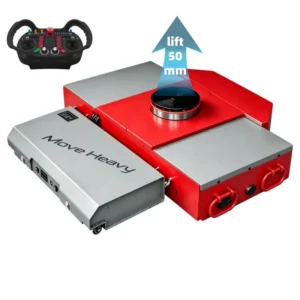
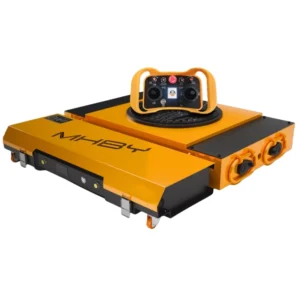
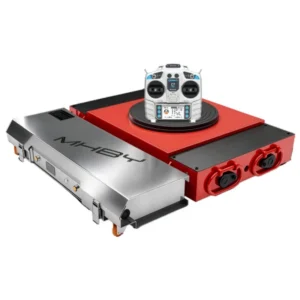
Increasingly, maintenance teams choose battery-powered machine skates (also called electric machine dolly skates) for machinery relocation. A single operator with a wireless remote can drive, steer, and stop loads up to 30 tons or more, moving at controlled speeds with precise positioning — no pushing, no crowbars, no workforce coordination on the load itself.
Key advantages over manual skates:
- One-person operation with remote control — reduces staffing per move
- Controlled speed on ramps and in tight aisles, where manual skates become unsafe
- 360° maneuverability for positioning machines within millimeters
- Lithium battery power — no cables across the factory floor, no fumes
4. Prepare the Route and the Machine
Once the method is chosen:
- Disconnect and lock out all utilities (electrical, pneumatic, hydraulic) following your LOTO procedure
- Drain fluids where required and secure loose parts and panels
- Protect the floor with steel plates if the route crosses weak joints or coated surfaces
- Mark the path and clear pedestrian traffic during the move
5. Execute the Move Safely
Position the skates under the machine’s designated lifting points — never under sheet-metal bases or unsupported overhangs. Jack the machine using toe jacks or machine lifts, slide the skates in, then lower the load slowly onto them.
During the move:
- Keep all non-essential personnel outside the marked zone
- Move at walking speed or below; never rush a heavy load
- Stop and re-assess at every turn, ramp, or door threshold
- Watch load behavior: a shifting machine means stop immediately and re-chock
6. Set, Level, and Reconnect
At the final position, jack the machine up again, remove the skates, lower it onto anchor points or vibration mounts, and level it with a precision machinist’s level. Reconnect utilities, run safety checks, and test the machine under supervision before releasing it to production.
Frequently Asked Questions
How much does it cost to move heavy machinery in a factory?
Costs depend on machine weight, moving distance, and method. Manual moves with rented skates may cost a few hundred dollars in labor; complex relocations with riggers and cranes can run into five figures. Battery-powered skates reduce recurring cost because in-house staff can handle moves without contractors.
What capacity machine skate do I need?
Add a safety margin of at least 25% over the machine’s total weight, and check that the load per skate stays within its rating at your machine’s actual center of gravity.
Can one person really move a 20-ton machine?
Yes — remote-controlled battery-powered skates are designed exactly for this. One operator controls drive, steering, and braking from a safe distance while the machine moves at controlled speed.
Conclusion
Safe machinery relocation comes down to planning, the right equipment, and disciplined execution. If your team relocates machines more than twice a year, a battery-powered machine skate typically pays for itself in saved labor and reduced downtime. Explore our Basic, Professional, and Lift machine dolly skate lines to find the right capacity for your plant.
-
Battery Powered Machine Skates 20-50T | Electric Load Mover with Lifting Function
Price range: $3,499.00 through $6,399.00Clear20T25T30T35T40T50T -
Electric Load Moving Skates 20-50T | Self-Propelled Skate
Price range: $2,499.00 through $4,899.00Clear20T25T30T35T40T50T -
Motorized Machine Skates 20-50T | Battery Powered Skate Basic
Price range: $1,988.00 through $4,188.00Clear20T25T30T35T40T50T -
Straight-line Auxiliary Wheels for Machine Skates (W6SP/W8SP)
Price range: $299.00 through $399.00Clear6 Wheels8 Wheels